Parker Bauer · 25 September 2026
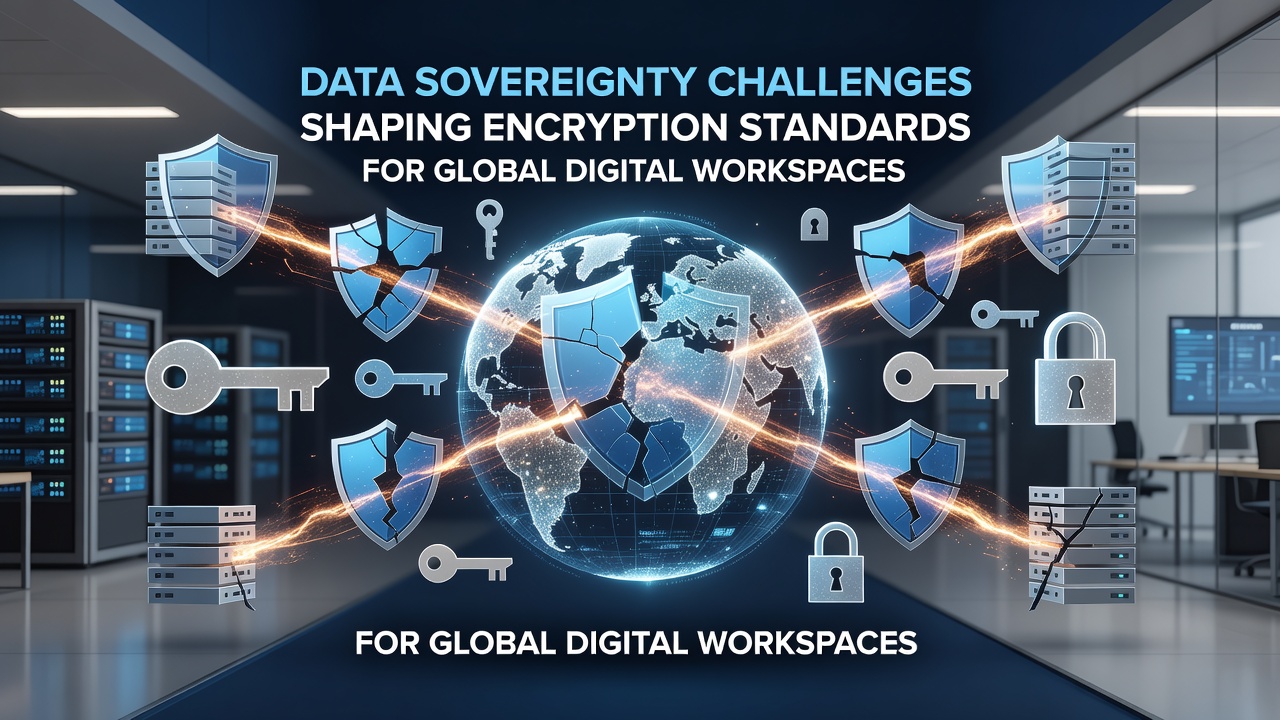
Data Sovereignty Challenges Shaping Encryption Standards for Global Digital Workspaces
Global digital workspaces operate under layers of data sovereignty rules that require organizations to store and process information within specific national boundaries, and these mandates directly influence the encryption methods teams deploy to maintain compliance while enabling collaboration across regions.
Countries enforce localization through statutes such as the European Union's General Data Protection Regulation, China's Personal Information Protection Law, and India's Digital Personal Data Protection Act, each specifying controls over data residency and access that encryption systems must accommodate without compromising security.
Regulatory Frameworks Driving Encryption Adaptations
Observers note that regulators in multiple jurisdictions updated enforcement priorities during 2025, with further clarifications issued in September 2026 that expanded requirements for key management and audit trails in cross-border platforms, and these updates prompted vendors to integrate region-specific key storage options into their suites.
Encryption standards respond because authorities often demand that decryption keys remain under local control or that algorithms meet approved certification levels, while organizations must reconcile these demands with the need for seamless access by distributed teams using shared workspaces.
Technical Impacts on Key Management and Algorithms
Teams handling international projects encounter situations where a single workspace spans servers in the EU, Singapore, and Brazil, forcing encryption architectures to segment keys according to each locale's rules, and this segmentation increases complexity around rotation schedules and access logging.
Research from standards bodies indicates that organizations increasingly adopt hybrid approaches combining AES-256 for bulk data with post-quantum algorithms in pilot deployments, since several governments signaled intentions to phase in quantum-resistant requirements by the end of the decade.

Regional Variations and Their Effects on Workspace Design
European regulators emphasize data minimization and explicit consent mechanisms that encryption tools must support through features such as granular access controls, whereas authorities in the Asia-Pacific region focus more on mandatory local processing that requires on-premise hardware security modules for key operations.
North American frameworks, including updates from the National Institute of Standards and Technology, prioritize interoperability and federal certification pathways that allow vendors to certify modules once and deploy them across compliant environments, yet these certifications still must align with foreign sovereignty expectations when data crosses borders.
One case study from a multinational engineering firm showed that implementing sovereign cloud instances with dedicated encryption gateways reduced compliance violations by aligning key custody with each country's statutes, although latency rose until network optimizations were applied.
Emerging Standards and Industry Responses
Industry groups have formed working committees to harmonize encryption profiles that satisfy overlapping sovereignty demands, and these efforts produced draft specifications for portable key formats that travel with data while respecting residency boundaries.
According to European Commission documentation, recent guidance stresses verifiable audit logs for encrypted data movements, prompting workspace providers to embed immutable logging directly into their encryption layers rather than relying on separate monitoring stacks.
Canadian and Australian agencies have issued parallel statements encouraging mutual recognition of certified encryption modules, which reduces duplication for vendors serving those markets simultaneously.
Practical Challenges in Implementation
Administrators report that maintaining consistent encryption policies across time zones becomes difficult when one region's update cycle conflicts with another's approval process, and this friction leads to staggered rollouts that leave temporary gaps in protection coverage.
Training programs now include modules on sovereignty-aware encryption so that end users understand why certain files remain inaccessible outside approved jurisdictions, and these programs draw on real deployment data to illustrate the consequences of policy misalignment.
Conclusion
Data sovereignty continues to reshape encryption standards by requiring adaptive key architectures, region-specific certifications, and enhanced audit capabilities that global digital workspaces must integrate to operate legally and securely across borders. Organizations track regulatory shifts from multiple authorities, including updates effective in September 2026, to keep their systems aligned with evolving mandates while supporting collaborative work.